




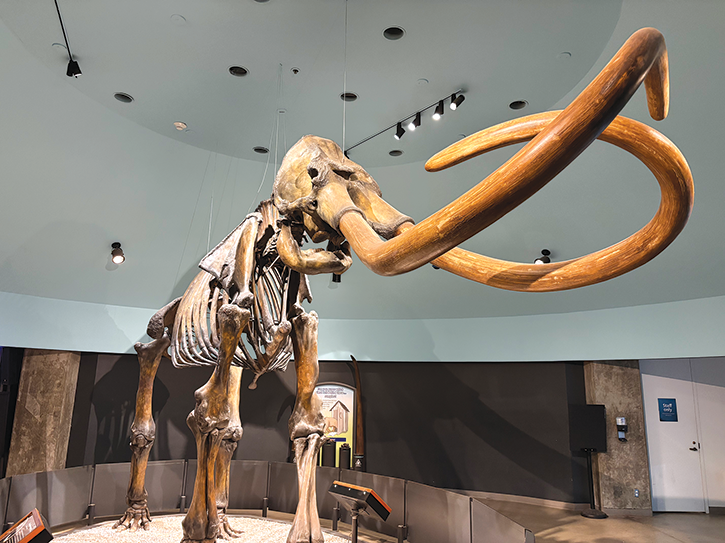
The La Brea Tar Pits’ collection of more than 3.5 million specimens includes Columbian mammoths on display. (photo by Tabor Brewster)
The La Brea Tar Pits’ collection of more than 3.5 million Ice Age specimens has received international recognition for its contributions to scientific research over the past century.
The International Union of Geological Sciences awarded the Rancho La Brea collection its GeoCollection Recognition, honoring its importance to the study of prehistoric ecosystems, climate change and extinction.
The designation follows the IUGS’ selection of La Brea Tar Pits as one of the world’s first 100 Geological Heritage Sites in 2022.
“The IUGS designation is a fitting recognition of this globally-important collection,” said Emily Lindsey, curator and excavation site director at the Samuel Oschin Global Center for Ice Age Research. “No other fossil collection on Earth has had as much impact on our understanding of the Pleistocene (Ice Age) – how extinct species lived, how ecosystems reconfigured in response to global climate changes, and what ultimately led to their collapse.”
The collection includes more than 3.5 million fossils representing over 660 species of birds, mammals, plants and invertebrates, along with soil samples. The specimens have contributed to nearly 1,000 scientific publications, including research on Ice Age amphibians and the social behavior of saber-toothed cats.
Nearly 100 visiting students and researchers from around the world study the collection annually.
The recognition was announced during the IUGS Geoheritage event in Algarve, Portugal, held Nov. 4-8. Regan Dunn, assistant deputy director and associate curator at the Samuel Oschin Global Center for Ice Age Research, delivered a presentation highlighting the collection’s contributions to research on climate change and biodiversity.
The designation comes as La Brea Tar Pits undergoes a major transformation of its museum and park. The project includes new facilities to preserve and study the collection, which continues to expand through ongoing excavations.
“This extraordinary honor punctuates the ongoing story of transformation and breakthroughs happening as La Brea Tar Pits’ Reimagining continues,” said Lori Bettison-Varga, president and director of the Natural History Museums of Los Angeles County.
The collection will eventually be housed at the Samuel Oschin Global Center for Ice Age Research, which will support research into how ancient ecosystems responded to environmental changes and extinction events.
Recent excavation efforts have placed greater emphasis on smaller organisms, including insects, fish, amphibians, reptiles and birds, many of which have living counterparts in Los Angeles today.
“As vital as our fossils have been to studies of the Ice Age over the past century, the potential impact of this collection will be greatly multiplied once we have the new facilities and resources to leverage it to its full capacity,” Lindsey said. “We are just getting started.”
The La Brea Tar Pits is located at 5801 Wilshire Blvd. For information, visit tarpits.org.




0 Comment