




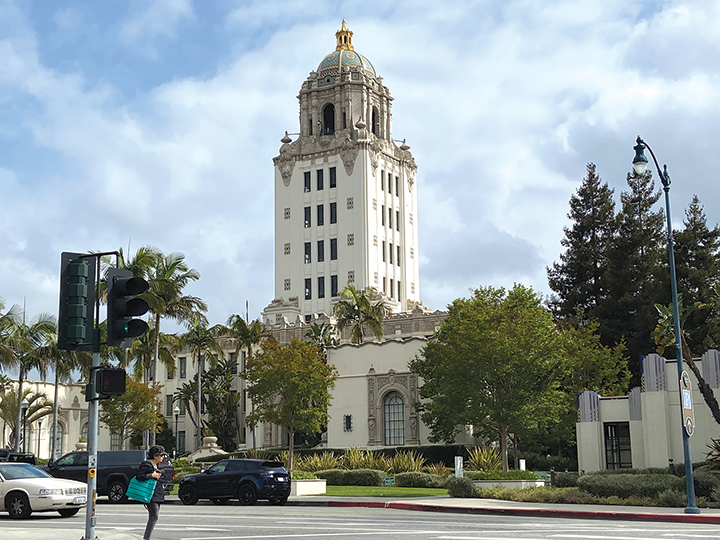
The city of Beverly Hills is considering expanding requirements for buildings to reduce emissions. Beverly Hills City Hall currently utilizes solar panels as a source of energy. (photo by Edwin Folven)
The Beverly Hills Planning Commission on May 22 began discussing the implementation of building and electric vehicle infrastructure reach codes, which aim to reduce greenhouse gas emissions throughout the city.
According to a city staff report, reach codes are local ordinances that “exceed and enhance the state’s green building standards.” Reach codes are often targeted toward building electric vehicle infrastructure and decarbonizing buildings. Reach codes have been implemented in cities including Los Angeles, West Hollywood and Santa Monica.
“Reach codes are a mechanism that allows local municipalities to achieve building decarbonization,” said Amanda Grossman, a sustainability programs administrator in the city’s Department of Public Works. “The adoption of a reach code was identified as one of the foundational measures in Beverly Hills’ climate action and adaptation plan, and can achieve significant greenhouse gas reduction with minimal cost to the city.”
The climate plan was approved by the City Council on April 22. The plan acts as a “living document” and a roadmap for the city’s climate policies as it faces the effects of climate change.
According to the California Public Utilities Commission, emissions from buildings in California amount to 24% of greenhouse gas emissions statewide. Decarbonization includes transitioning appliances that use natural gas and oil – gas stoves, hot water heaters, boilers and furnaces, for example – to a zero-emission source of energy. Zero-emission buildings often utilize electricity instead of natural gas and benefit from infrastructure including solar panels.
The city is currently exploring three different approaches to reach codes for building decarbonization – “energy performance,” “flex path” and “electric readiness,” which differ in specific electric infrastructure standards that would be required for new buildings and substantial remodels.
The city is also considering two different methods of enforcing reach codes – through requiring specific energy efficiency or renewable energy measures in buildings, or requiring buildings to meet an energy “budget” or performance score.
City staff will perform an analysis of the possible reach codes and return to the Planning Commission with recommendations in the fall. According to the staff report, the city expects to submit an ordinance to the City Council in late fall. Upon approval, the ordinance would be reviewed by the California Energy Commission. The city aims to implement an ordinance by January 2026.
While the Planning Commission did not take an action on the item, Commissioners Gary Ross, Lou Milkowski and Commission Vice Chair Jeff Wolfe appeared to support the examination of reach codes in Beverly Hills. Commission Chair Terri Kaplan and Commissioner Myra Demeter were absent.
“This is a very important area,” Milkowski said. “I like to see us catch up, if we call that catching up.”




0 Comment