




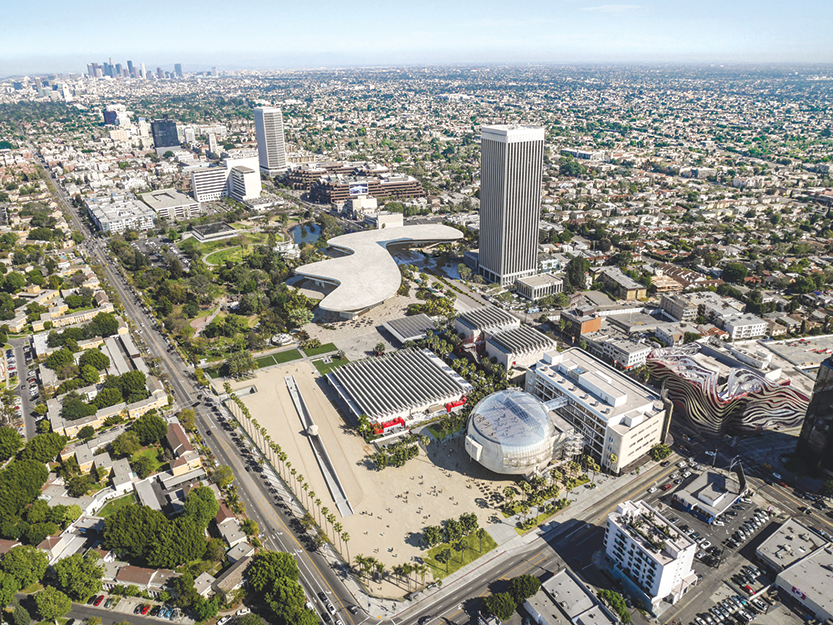
The new building at LACMA will span Wilshire Boulevard on the Miracle Mile, as shown in this rendering. (rendering courtesy of Atelier Peter Zumthor & Partner/The Boundary)
The Los Angeles County Museum of Art has announced a $50 million gift from the W.M. Keck Foundation that coupled with other donations, places the museum on track to reach its $650 million goal for its “Building LACMA” campaign.
More than $640 million has been raised thus far. The museum’s David Geffen Galleries, a new building that will span Wilshire Boulevard, connects with the street’s southern side at Spaulding Avenue. The goal is to reach the $650-million mark by the end of February. When the money is raised, LACMA plans to get underway with major construction. Four of the museum’s longstanding main central buildings are currently closed, and crews are preparing for demolition and construction of the new galleries.
“We are truly honored by the Keck Foundation’s extraordinary generosity in moving our building plan forward as we increase our broad outreach to communities,” LACMA CEO and Wallis Annenberg Director Michael Govan said. “Our community of donors is throwing their support behind our vision of how an art museum can nurture and celebrate our diverse city through historical and contemporary art from around the world.”
“The Keck Foundation strives to enrich the lives of Southern California residents and places special emphasis on children, youth and their families. We are inspired by Michael’s vision of an art museum for all,” added Robert Day, chair and CEO of the W.M. Keck Foundation. “Along with our new Keck Foundation co-presidents Joe Day and Stephen Keck, we are particularly excited about the museum’s goal of improving access to art and art education for Angelenos from all parts of our region for many years to come.”
Once the $650 million for construction costs in secured, LACMA will continue fundraising for another $100 million needed for additional costs. A groundbreaking ceremony will be held soon for the project, but a date has not yet been scheduled, said LACMA spokeswoman Jessica Youn.
The David Geffen Galleries are part of a plan to improve the museum’s space and open other areas where buildings currently exist for other art-inspired uses. The project includes seven semi-transparent pavilions that will support a single elevated exhibition level with a floor-to-ceiling glass perimeter. The project is designed to offer visitors new ways to experience the museum’s collection and enjoy programs. Designed by architect Peter Zumthor, the new galleries will have approximately 347,000 square feet of area and approximately 110,000 square feet of gallery space. It will also create 3.5 acres of new public outdoor space where programs and exhibits can be held.
Having more open space will provide additional access for paleontological research at the La Brea Tar Pits and Museum and will give visitors more recreational space in the surrounding park, according to museum officials.
LACMA will remain open during the construction project, exhibiting works in other existing spaces such as its Broad Contemporary Art Museum and Resnick Pavilion, outdoor areas and at satellite locations in the community. The David Geffen Galleries are anticipated to be complete in 2023, with an opening scheduled in 2024.
The project has received mixed reaction in the local community.
“I think it will be a tremendously positive addition to the Miracle Mile. This is going to be a major national and international destination,” Greater Miracle Mile Chamber of Commerce President Stephen Kramer said. “I really like the fact that it challenges the visitor and exposes the visitor to new concepts, with the art and the structure as well.”
Others remain opposed, including Greg Goldin, a Miracle Mile resident and former art critic for Los Angeles Magazine, who said LACMA has not been forthcoming about the plans, specifically how the money is being spent. He added that the design is not cohesive with how he believes the museum’s collection should be displayed.
“There is no fiscal accountability, there is no architectural accountability and no accountability to the curatorial mission of this very important institution,” Goldin said. “The issue is the building is getting smaller and the cost is getting larger. We need to reopen the process. It’s not too late.”




0 Comment