




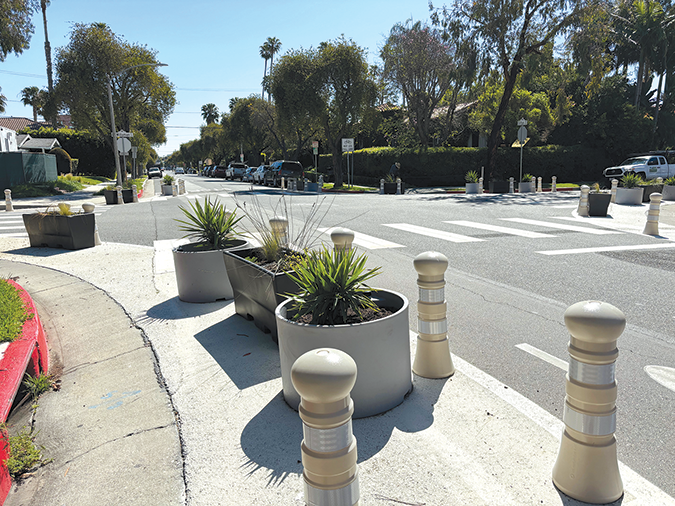
City staff announced the results of a traffic-calming study on Clifton Way, which included the installation of curb extensions at four intersections. (photo by Tabor Brewster)
The Beverly Hills City Council at its Nov. 19 study session considered issues relating to transportation and traffic on two different streets within the city. The council received two reports on traffic along Clifton Way and Coldwater Canyon Drive.
City staff shared the results of a six-month traffic-calming study on Clifton Way between Robertson and La Cienega boulevards. The six-month demonstration included two traffic circles and four curb extensions at six intersections along Clifton Way. The city collected data on vehicle speeds and stop sign compliance with tube counters and video analysis.
According to the city staff report, traffic on Clifton Way decreased by 1% overall, and most vehicle speeds remained consistent. However, the maximum speeds recorded on Clifton Way decreased from the 45-50 mph range to 35-40 mph range.
Transportation planner Jessie Holzer Carpenter said the decrease in high speeds was significant because higher vehicle speeds are more likely to result in fatal and severe injury collisions.
“A reduction in maximum speeds has the potential to significantly improve safety and livability,” Holzer Carpenter said.
The study found there was no consistent change in stop sign compliance along Clifton Way. The two intersections with traffic circles saw a modest reduction in vehicles not stopping at all.
“However, those two intersections also had modest increases in rolling stops as compared with complete stops,” Holzer Carpenter said.
The study also surveyed the community for feedback. The city received 214 responses from residents. According to the results, traffic circles were more favorable among the community than curb extensions. Approximately 52% of respondents believed the traffic circles were successful while 40% of respondents believed the curb extensions were successful.
Overall, 60% of respondents indicated interest in keeping traffic-calming measures on Clifton Way while 40% favored removing them.
In a Nov. 7 meeting, the Traffic and Parking Commission voted 3-0 to recommend keeping the project. The commission suggested upgrading the traffic circles to permanent materials and maintaining the curb extensions with modifications to make vehicle navigation easier.
According to the staff report, the current maintenance cost for the traffic-calming measures is $8,000 per year. Construction of permanent traffic circles would cost $50,000-$75,000 per intersection with landscaping or $25,000 per intersection without landscaping. Construction of permanent curb extensions would cost $100,000-$300,000 per intersection.
After input on the curb extensions, the council ultimately voted to continue the study. The council hopes to seek further results on narrower curb extensions to allow more space for cars to navigate through each turn. One intersection will receive a significantly smaller curb extension to compare results and feedback, one curb extension will be removed and one will be converted to a traffic circle.
“I don’t like the curb extensions at all but I think if we’re testing we should test,” Mayor Lester Friedman said.
The City Council was also presented the results of a study on proposed crosswalks on Coldwater Canyon Drive. Some residents have raised concerns over the lack of crosswalks on the street and high vehicle speeds. The city contracted Fehr and Peers, a transportation solutions firm, to study the feasibility of traffic signals, stop signs and pedestrian hybrid beacons – crossing signals that are activated by a button – along Coldwater Canyon Drive.
The study analyzed the number of pedestrians crossing at five intersections along a one-mile stretch of Coldwater Canyon Drive as well as the number of collisions at each intersection. However, the study found that the data did not meet the criteria to install traffic signals, stop signs. However, it found that pedestrian hybrid beacons could be considered.
The council ultimately voted to study the installation of one pedestrian hybrid beacon on Coldwater Canyon Drive. The study will determine the best intersection to place the beacon with the least impact on residents.




0 Comment