




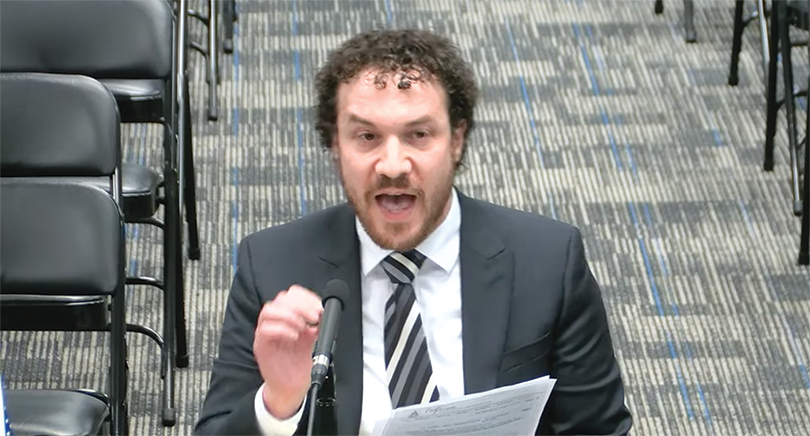
Attorney and district parent Daniel Lifschitz filed the lawsuit in January, challenging the board’s selection of vice president. (screenshot courtesy of BHUSD via YouTube)
A Beverly Hills Unified School District parent who sued the district in January over its Board of Education’s vice presidency is now seeking a court order to install board member Amanda Stern as vice president in 2027 and president in 2028.
The lawsuit, filed by attorney Daniel Lifschitz against the district, Board President Judy Manouchehri, Vice President Sigalie Sabag and Board Member Russell Stuart, is scheduled to go to trial on Dec. 1 before Los Angeles Superior Court Judge Tiana J. Murillo.
In a series of court filings ahead of the trial, Lifschitz and attorneys representing the district and the three board members outlined their opposing arguments, including whether Stern violated California’s open meeting law and whether the court has the authority to determine the board’s leadership for the next two years.
The lawsuit stems from the board’s Dec. 16, 2025, organizational meeting, during which Manouchehri, Sabag and Stuart voted to elect Sabag as vice president, despite a board bylaw that established a rotational system for selecting the vice president based on trustees’ length of service and the number of votes they received in their most recent citywide election.
Under the rotation, Stern was next in line to serve as vice president.
At a Jan. 13 meeting, board members accused Stern of violating the Brown Act by privately communicating with fellow trustees about the vice presidency ahead of the December meeting. On Jan. 27, one day after Lifschitz filed the lawsuit, the board amended its bylaws to eliminate the rotational system and subsequently reelected Sabag in a 3-2 vote. The board also eliminated the clause that prohibited board members from serving more than one year as either vice president or president.
In his Oct. 2 trial brief, Lifschitz argued that the board was legally obligated to elect Stern under the bylaws in effect at the time of the December meeting.
“This case is about whether a public school board may break its own rules, then contrive an excuse to rewrite them on the fly and seize a result the law forbids,” Lifschitz wrote.
While Lifschitz initially sought to compel the board to elect Stern as vice president for the remainder of 2026, he now argues that delays in the litigation have effectively deprived Stern of her opportunity to serve in the position and that she should instead serve as vice president in 2027 and president in 2028.
In a Nov. 2 court filing, attorneys representing the respondents argued that the board acted within its authority in amending its bylaws and subsequently reelecting Sabag. They also maintained that Stern’s communications with fellow trustees constituted a violation of the Brown Act, citing deposition testimony obtained during the litigation.
According to the filing, Sabag and Stuart testified that Stern had sought their support for her vice presidency ahead of the December meeting. Manouchehri also testified that Board Member Rachelle Marcus told her that Stern had sought her vote.
However, Lifschitz disputed the allegations, citing Stern’s own deposition testimony and arguing that the individual conversations did not constitute an unlawful serial meeting. He also challenged the admissibility of Manouchehri’s testimony regarding Marcus, who was not deposed in the case.
The respondents further argued that even if no Brown Act violation occurred, the board had the authority to reconsider its December election.
Attorneys for the respondents also argued that Lifschitz’s request to install Stern as vice president in 2027 and president in 2028 extends beyond the scope of the original lawsuit and would interfere with the authority of future school boards.
“Mr. Lifschitz would like the court to decide those future elections now, for members who are not before the court, under a bylaw that no longer exists. That the court should not do,” attorneys for the respondents wrote.
On Nov. 9, attorneys for the respondents submitted a request for judicial notice of the Nov. 3 election results, citing a change in the composition of the board. Manouchehri secured reelection, while district parent David Cienfuegos is set to succeed Marcus on the board.
Dan Lifschitz’ wife Kim Lifschitz also ran unsuccessfully for a seat on the board in the recent election, finishing in fourth place behind her ally Jackie Kruger. The two sought to bring new leadership to the district and publicly opposed the current board majority.
In a Nov. 13 reply brief, Lifschitz argued that Manouchehri’s reelection bolstered his case, as all three trustees named in the lawsuit will remain on the board and constitute a majority capable of electing Stern. He argued the court could grant the requested relief without compelling Cienfuegos to vote for Stern.
Lifschitz characterized the case as a bellwether for the board’s future actions.
“John Stuart Mill once said that the triumph of evil requires little more than for good men to look on and do nothing,” Lifschitz said in a statement. “I filed this case because I suspected the board’s treatment of Dr. Stern presaged a new era of lawlessness for BHUSD unless somebody stood up to them, and over the last 10 months, they have proven me right at every turn.”
He further alleged that the district has attempted to retaliate against himself and his family.
“For the sin of seeking accountability, they went after my job, my wife and my disabled child,” Lifschitz continued. “They violated court orders, lied under oath and paid six figures to five sets of lawyers in defense of petty tyranny. None of it saved them from next week’s trial, where I intend to prove once and for all that the law is not merely a polite suggestion. Hopefully the message will reach them.”
A BHUSD spokesperson said the district does not comment on ongoing litigation.
The board is scheduled to hold its next annual organizational meeting on Dec. 15, two weeks after the trial, to select its leadership for 2027.







0 Comment