




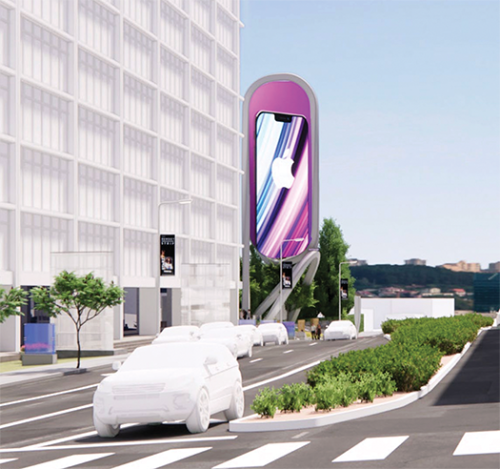
9200 Sunset Blvd. is set to gain a new digital, animated billboard. (rendering courtesy of the city of West Hollywood)
Another cutting-edge billboard was approved for the Sunset Strip, this time at 9200 Sunset Blvd. The uniquely shaped vertical, animated digital sign was OK’d by the West Hollywood City Council on Jan. 20 by a 3-1 vote, with Councilman John Erickson recusing himself and Councilwoman Lauren Meister dissenting.
The project would include not just digital advertising, but a pedestrian plaza and plaques embedded into a feature wall that would highlight the history of the Sunset Strip.
Erickson recused himself because of the Levine Act, which prevents public officials from participating in projects that involve potential conflicts-of-interest in terms of campaign contributions. When reached for comment, Erickson stated that all documents related to campaign contributions are publicly available.
Meister asked questions about the lighting effects of the sign, which previous incarnations of the design had shown that the light might disturb residents at Sierra Towers on nearby Doheny Road. Previously, the sign was to have been static, but it is now to be full motion.
“The original project, the light study showed that light did trespass to Sierra Towers – like the first three floors, or something like that.” Meister said.
“We have met with a representative of residents of Sierra Towers and shared the lighting study from Dark Horse Lighting, and there were no further comments or concerns from that representative,” said Ben Anderson, a representative of the architecture and design firm OFFICEUNTITILED.
While no residents spoke against the project in chambers, Meister read an email from one resident who was not in favor of the sign, one of several that were received from residents of Sierra Towers.
“Because my unit sits high above the street, I fall directly into the horizontal beam path of the proposed LED display. No amount of shielding designed for street level mitigation will prevent light trespass, flicker and motion intrusion into my home,” Meister read. “Full Motion, digital signage produces continuous movement and high intensity illumination that blinds or curtains can simply cannot block at elevation. The result would be persistent visual distraction, nighttime light intrusion and a degradation of my ability to use and enjoy my living space, including impacts on sleep, privacy and basic day to day comfort inside my own home.”
In response to this concern, Meister explained her opposition. “I understand that we get a lot more as a city [financially], but I also think that it’s a balance for us to help our residents maintain some quality of life, and they deserve to have that,” she said.
The other council members were in support, noting that the sign would provide large amounts of revenue for the city through a profit-sharing plan. Additionally, recently-appointed CEO and president of the West Hollywood Chamber of Commerce Leonard Lanzi spoke in support of the billboard.
“This project reflects where the city is headed with its updated billboard policy,” Lanzi said. “It brings new creative digital imagery to the strip in a way that supports the Los Angeles broader digital art program and keeps the Sunset Strip at the forefront of global outdoor media. But what’s really important is that this project isn’t just about a billboard. It makes meaningful improvements at street level, adding pedestrian plazas, seating and landscaping that invite people to slow down, gather and actually enjoy and experience the strip, rather than just pass through it.”
According to a staff report, the city is expected to gain over $47 million in revenue from the sign over a 30-year period.
Councilman Danny Hang noted that the current federal administration was cutting millions in social services and that the revenue from such signage would integral to West Hollywood’s operation.
“We’re lucky that we have revenue generating sources in this city that’s creative and cool,” he said. “I think this project will affect the overall quality of life for the entire community over the next 30 plus years, given that all of the revenue generating that it will have for our city.”
Mayor John Heilman noted that improvements to the design from previous incarnations made it less intrusive to nearby residents.
“While I do appreciate and understand people’s concerns about the signage program, generally, in terms of the specific impacts that people are concerned about I think the lighting study and the environmental report and the location of the sign tells me that those impacts are not real,” Heilman said. “There’s less impact, in my mind, on the residents based on the way the sign is configured, and it’s a nicer design.”
Billboard time will also be afforded to the city, and the lighting standards are supposed to be updated in accordance with evolving West Hollywood guidelines every eight years. No timeline has yet been presented on its construction.



0 Comment