




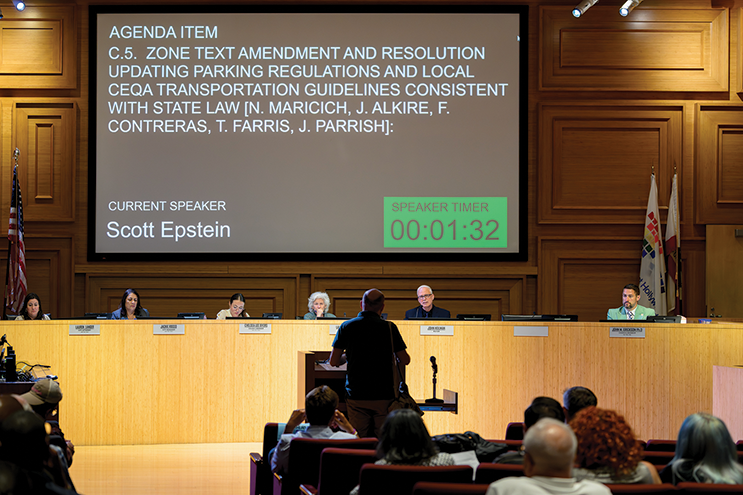
The West Hollywood City Council discussed various housing-related items at its June 15 meeting. (photo by Jon Viscott)
The West Hollywood City Council on June 15 discussed aligning its parking requirements for residential properties with the state of California. The city also proposed eliminating required spaces entirely to accelerate development. This idea was met with resistance from the public, many of whom also spoke about the city’s potential future impacts from Senate Bill 79.
SB 79, which allows for high-density housing within a half mile of major transit stops, currently does not apply to West Hollywood, though the city’s inclusion may change with the construction of the Metro K Line Northern Extension in future decades. Also on the meeting’s consent calendar, which includes items that were not discussed by the council, was an update on SB 79. At the May 18 meeting, the council had discussed, but made no determination on, whether to adopt a Transit Oriented Development Alternative Plan. A TODAP provides cities with more control over how to implement housing density required by SB 79. The city of Beverly Hills approved a TODAP on June 9.
Additionally, West Hollywood has held meetings with residents over a Zoning Improvement Plan. City staff was directed by council to include preparedness for future transit maps, which are drafted by the Southern California Association of Governments, that may include West Hollywood and require the city to decide on implementing a TODAP into its ZIP.
During the public comment period, several residents asked the council to consider preemptive action.
“Given the complexity of the process and the importance of meaning meaningful public engagement, waiting until the stations are officially mapped could significantly reduce the city’s flexibility and residents’ ability to help shape future growth,” resident Mike Holtzman said. “A TODAP is not about opposing housing, it is about planning growth responsibly.”
Still, others encouraged the city to embrace SB 79.
“SB 79 has some of the best protections that we’ve seen for rent stabilized units, while allowing the housing that we desperately need to be built and doing it near transit, which will cut down on traffic,” resident Helen Krieger said. “We have a chance through our ZIP process to create SB 79-ready zoning that’s adapted to the unique needs of our community. My ask for you here tonight is to please not make this process never ending.”
For the June 15 meeting, the City Council only had to update its zoning code to align with Assembly Bills 1317 and 894, which require property owners to make underutilized parking spaces publicly available and requires some residential owners to unbundle parking from rent prices, respectively. Further, the city considered a zone text amendment first proposed in May 2025 which directed council to remove parking minimum requirements entirely from new builds. As residents weighed in and the council discussed, it was clear that there was not a consensus on how to handle this amendment. Additionally, there were discussions on the specifics of renting out underutilized spaces to non-tenants.
Councilwoman Lauren Meister grilled staff on the specifics of the ordinance, bringing up several points – such as the pricing of spaces – from the perspective of car-dependent West Hollywood renters.
“The reason I’m asking the questions is I didn’t see it in the ordinance and I didn’t see it in the staff report, and my feeling is I’m not going to vote for something that has not been thought out completely with regard to these use items,” Meister said.
“I am really grateful for some of the points that Councilmember Meister raised, making sure that while we’re seeking to create a more predictable, consistent and transparent map for those who will seek to build in our city, that we’re doing the same for those who are renting in our city,” Councilwoman Chelsea Byers said. “So, I think it doesn’t have to, for me at least, be a part of the zone text amendment, but rather something that we do to come back [to us later], making sure that we’re clear on what language would go into a lease.”
Councilman John Erickson, who initiated the item, was supportive of the amendment.
“The science is there,” he said. “It’s not arrogance. It’s written down in a book that people should read. But additionally, structured parking can cost $50,000 to $100,000 per space to build, and underground parking can cost even more. Those costs get passed on to renters and home buyers. It’s proven. It’s factual. We should prioritize homes for people, not parking for cars. It costs more to build a parking space than it does to build an affordable housing unit.”
The residents in attendance were largely against reducing parking availability.
“Parking is a premium resource for our people here in West Hollywood,” resident Anita Goswami said. “The state has taken away some, but West Hollywood is able to retain local control, so please don’t give away what you’ve got.”
Goswami brought up that the amendment might result in older residents having to walk farther between their homes and cars.
“We’re trying to encourage aging in place, at least I thought we were, and we have a larger older adult population,” Meister said.
Scott Epstein, director of policy and research at Abundant Housing LA – who also spoke in support of SB 79 – encouraged the council to eliminate parking requirements.
“You would be the second city in L.A. County to support the complete elimination of parking minimums citywide,” Epstein said. “This is a bedrock of pro housing policy, and really it’s just cleanup in the city of West Hollywood … you will be saying firmly that this is an aggressive policy that [doesn’t incentivize] driving and drives up the cost of housing for no reason.”
Ultimately, Heilman told staff to return to the council at a later date with an amended item that includes just the alignment with California’s zoning laws, with the other recommendations to be unbundled for future consideration. With the absence of Vice Mayor Danny Hang from the meeting as well, it was unlikely the four-member quorum would have voted in favor of the reduction in parking requirements.
A less controversial housing-related item was brought forward later in the June 15 meeting by Meister that directed city staff to look at regulations for storage and amenity spaces in new residential developments to ensure that amenity space loopholes were not being used to limit affordable housing units.
“The item directs staff to evaluate zoning amendments that would prevent developers from using oversized storage or amenity spaces as a loophole to later create market rate ADUs while avoiding affordable housing requirements,” Meister said. “The proposal seeks to ensure that spaces labeled as storage or amenities are genuinely intended for those purposes, and to explore state legislative changes that would preserve affordable housing opportunities when such conversions occur.”
The ordinance passed 4-0.







0 Comment