




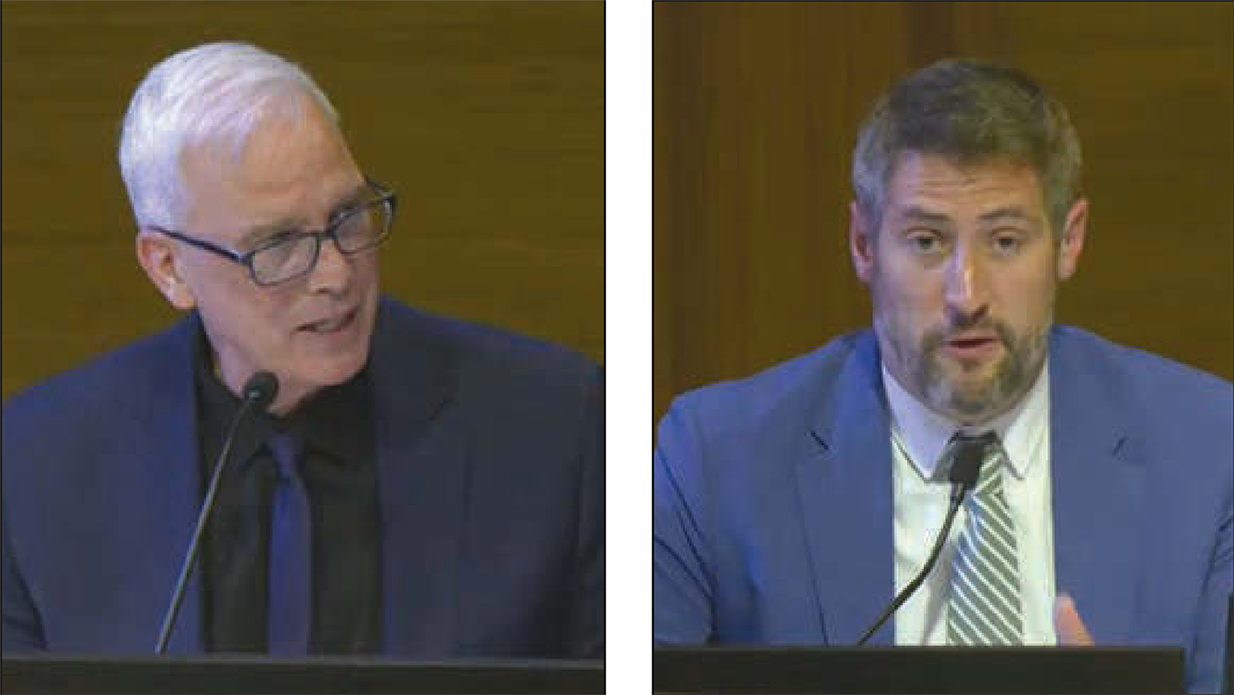
The West Hollywood City Council meeting dragged on for nearly seven hours on May 18, with much of the time spent discussing Mayor John Heilman’s item that proposed a potential city response to Senate Bill 79, which would establish a Transit Oriented Development Alternative Plan.
During council member comments, it became clear that Heilman had the support of Councilwoman Lauren Meister and the opposition of Councilwoman Chelsea Byers and Councilman John Erickson, with Vice Mayor Danny Hang remaining undecided. Ultimately, no vote was held, with the item continued until June 15, which will be the next regular meeting for the council.
Senate Bill 79 overrides local zoning codes, allowing for increased density housing within a half mile of major transit stops. With the approval of the Metro K Line Northern Extension, West Hollywood will be gaining three major transit locations that would fall under SB 79. It is unclear, at least until the state releases the maps with areas affected by the bill sometime in June, if SB 79 will automatically affect West Hollywood, even though the K Line extension is potentially decades away from completion.
Heilman’s proposal took a part of SB 79 that allows for cities to plan where increased housing will be built, avoiding potential impacts on smaller neighborhoods. Byers and Erickson argued that these discussions were already ongoing with Zoning Improvement Plan meetings, which the city has engaged with the community over the last few years. There was uncertainty, however, whether ZIP recommendations – which have not yet been made to the planning commission or council – would ultimately be void because of state housing mandates, or if the city would have to adopt TODAP, as Heilman proposed, to have control over housing density.
Byers argued that these specifics ultimately did not matter, and that increased housing was necessary.
“We’re far too restrictive in how we’re allowing housing to be built right now, and by allowing it to take place more equitably, we can allow every neighborhood to have different types of housing,” Byers said. “It’s not erasing anything, it’s allowing the possibility of something more, and I know again that’s very frustrating to imagine that you may be living next to a building that looks different years from now. That’s what happens to cities: they grow, they change, they evolve.”
Hang wanted to see the maps issued by the state to clarify what parts of West Hollywood would be included before moving forward.
“I don’t think it’s really unreasonable for people to want to clarify what this new law could mean for their neighborhood, and also want to express … I want to ensure that we’re protecting existing rent stabilized units,” Hang said.
Hang discussed his own family’s struggles with immigrating to the United States, working as small business owners and eventually owning their own home.
“How do we balance neighborhood concerns with the reality that many homeowners view their property, like my parents, as their primary investment for their kids or for even for their retirement? Because that for me is kind of like the free capital market telling people what they can or cannot do with their property, especially if they made a long-term investment by working 30 years and they’re not able to sell when they are ready to sell it,” he said.
“SB 79 creates billions of dollars in revenue for WeHo so we can actually build a subway, and we have to meet those dollar amounts that we have to do,” Erickson said. “Future subway stops and upzoning increases property values … that we want to do anything to downzone areas is just … I just don’t understand why.”
Heilman said that there should be clarification from the state on whether the K Line would be included in the initial maps.
“It doesn’t make sense for us to trigger SB 79 and have new buildings built if there isn’t financing for the rail line, and the rail line never gets built, that would be the worst of both worlds … getting all of the housing, but no transit,” he said.
Meister and Heilman argued that the city should exert whatever control it can now.
“As a previous planning commissioner myself, and as someone who has watched way too many years of planning commission meetings, my head is exploding,” Meister said. “I mean, to allow 79 to go through with no plan … it’s not smart. And you know what? If you relinquish local control to this state, when you have an opportunity to maintain some of that control, there’s no point in being a council member.”
“I would like to see us give direction to the staff to look at how to incorporate a transit-oriented alternative plan into our ZIP work,” Heilman said.
Dozens of residents spoke on the issue, with all but one in support of the TODAP.
“None of us was given the impression or information to understand that in supporting the Metro, which would allow us to walk and ride and not have to drive, we were going to give up really, really important elements of our lives and our neighborhoods, and it’s really disturbing to think that council members aren’t willing to at least consider TODAP and ways to avoid impairing what people already have,” public safety commissioner Kimberly Winnick said.
“Without a TODAP, Sacramento’s one-size-fit- all SB 79 standards take effect, and according to your own staff report, could impact nearly every zoning district in West Hollywood, bringing taller buildings, reduced parking setbacks and increased development pressure into residential neighborhoods,” resident Jay Jacobson said.
“I’m calling in regards to advocating for affordable housing that I feel has been lackluster and has not been of ample volume that the city had 40 years to accomplish,” resident Jamie Francis said, who spoke over Zoom and dissented with other commenters. “Unfortunately, because of NIMBYism and NIMBYist, especially those previous speakers tonight, they have been able and afforded to live in the city for 40-plus years. With gentrification that’s happening, with their property values that increase, only they can speak about this, because they’ve been afforded the luxury and the ability to live in this community.”
There was also discussion over the definition of “redlining,” which has typically been associated with discriminatory practices to keep minorities from home ownership. Residents used the term to describe SB 79’s half-mile radiuses, which Erickson took issue with, but Heilman clarified that redlining’s definition has been broadened in recent years.
“I agree with council member Erickson that redlining certainly has been used as a way of excluding people of color from certain areas, but the term ‘redlining’ has been expanded, and it has been used in other ways, as well,” Heilman said. “In our early years as a city, we were concerned about insurance redlining. Redlining West Hollywood so that our insurance rates were higher. So, I agree. I don’t want any racist tropes being utilized. I don’t think the term redlining … because of its broadened definition … I don’t think the intent was to use it in that way.”
The boisterous meeting saw Heilman often having to rein in attendees, who frequently spoke over council comments, particularly Erickson and Byers. At one point, at roughly the six-hour mark of the meeting, Erickson addressed one attendee directly.
“It’s my turn to speak, not yours. I’m so sorry, I listened to you for an hour-and-a-half. Please respect up here,” he said.
Heilman asked Erickson not to get “into disputes with the audience,” and Erickson shot back that he wanted Heilman to control the meeting “like I asked you to during the break.” Soon after, when interrupted again, Erickson seemed to imply that the community member should be removed from the meeting.
“If I’m removing people, it may include some of the council members, too,” Heilman said. “Which I don’t have the authority to do, so let’s keep going here and see if we can ask the audience to restrain themselves, and I would ask all of us to restrain ourselves as well.”
“I think you owe me an apology on that one, Mayor Heilman,” Erickson said.
“Yeah, you’ll get it later. Thank you,” Heilman said.
The next West Hollywood City Council meeting will see the issue come up yet again and is scheduled for 6 p.m. on June 15.




1 Comment
EVERY resident and business owner in WeHo should watch that city council meeting and decided for themselves who were the good guys and who were the bad guys! It was pretty obvious!