




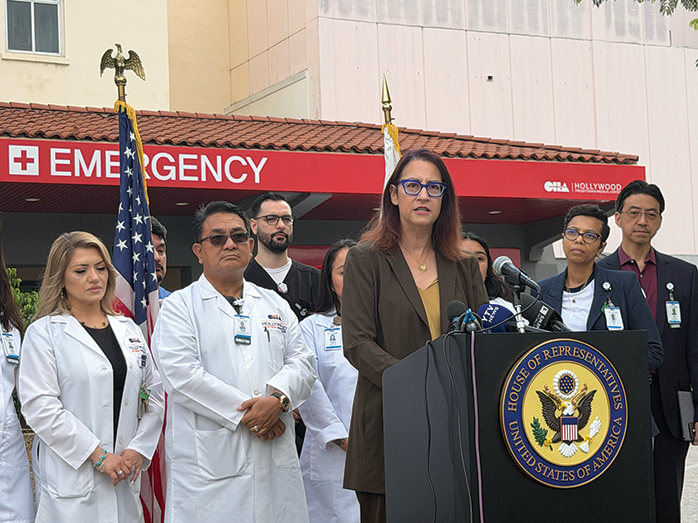
Rep. Laura Friedman spoke outside Hollywood Presbyterian Hospital in October, explaining the need for ACA tax credit extensions. (photo by Rance Collins)
U.S. Rep. Laura Friedman (D-Glendale) was part of a group of House members who helped force a vote on Jan. 9 extending subsidies for the Affordable Care Act. The three-year extension was blocked in the Senate on Jan. 14, meaning this issue of healthcare is likely to remain a focus during an election year.
For Angelenos, the cuts affect the cost of Covered California, which was created in conjunction with the ACA. Friedman said in a Jan. 13 interview that Speaker of the House Mike Johnson did not want to bring the legislation to the floor for a vote, but nine Republicans joined Democrats advancing a procedural vote and then 17 Republicans joined all 213 Democrats to vote in favor of keeping the subsidies.
“The Democrats spending months now communicating with the American public and explaining what was at stake – being united, being on message and being relentless and being out in the public, doing the town halls, doing the press conferences and doing the one-on-one meetings with the public to show them what was going to happen to their coverage … [That], coupled with people getting their renewal notices and seeing that we were not making this up – that there were huge spikes in their insurance premiums – ended up putting enough pressure on House Republicans to get the discharge petition qualified,” Friedman said.
The 230-196 vote was a twist in an ongoing battle to determine the future of health care in the United States. A protracted government shutdown in October and November 2025 largely centered on the extension of health care subsidies, which ultimately lapsed at the beginning of January. Republican lawmakers and President Donald Trump have promised a new health care package.
“Clearly, they’ve had many years to come up with a replacement to the Affordable Care Act, many years, and they failed to do so,” Friedman said. “And the fact that they’re only [trying to come up with a replacement] in the last couple weeks shows that not only are they not serious, that they never thought that health care was a priority.”
Friedman said that she hoped the Senate’s Republican-majority would “listen to their constituents,” though the bill ultimately did not meet the 60-vote threshold to be heard on the Senate floor.
“They’ve thrown out a whole bunch of ideas, all of which are completely half-baked. [They’ve] put absolutely nothing formal in front of the public or in front of Congress,” she said. “Certainly, [they] haven’t come up with anything that’s comprehensive, that will actually solve the problem. So, they’re going to have a binary choice of voting for an extension or letting their own constituents go without health care.”
Republicans who voted against extending the tax credits argued that government should focus on insurance as a whole and not just the ACA.
“Only 7% of the population relies on Obamacare marketplace plans,” Rep. Jason Smith (R-Missouri) said, according to PBS. “This chamber should be about helping 100% of Americans.”
Friedman noted that even those not receiving coverage through the ACA or Covered California will “see a hit” in their premiums.
On Jan. 14, Friedman further criticized the Senate’s blocking of the subsidies.
“It is absurd that Senate Republicans have chosen to ignore the will of millions of Americans who want Congress to pass ACA tax relief so that they and their kids can afford to go see a doctor,” she said. “The House passed this relief by a strong, bipartisan margin, so the Senate has no excuse not to do the same. I will stay in this fight because health care is an essential not a luxury.”




0 Comment