




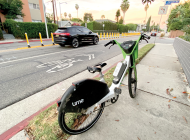
The West Hollywood City Council approved a streetscape project for Fountain Avenue that includes a protected bike lane and other traffic calming measures. (photo by Rance Collins)
Following years of contentious disagreement and controversy, the West Hollywood City Council approved an update to the Fountain Avenue Streetscape Project in three separate votes on Sept. 15.
The council approved plans for Phase 1 of the project and an agreement for services with transportation planning and engineering firm Fehr and Peers for the amount of $131,040 in a 3-2 vote, with Councilmembers John Heilman and Lauren Meister dissenting. The council unanimously approved implementing immediate traffic calming measures on Fountain Avenue, approved staff to report back on removing peak hour parking restrictions and authorized city staff to initiate Phase 2 of the project, which includes gathering proposals from design firms as well as an expansion of the steering committee for Phase 2. The council approved an exemption for the project from the California Environmental Quality Act in a 3-2 vote with Meister and Heilman again dissenting.
The streetscape project will redesign Fountain Avenue from La Brea Avenue to La Cienega Boulevard. Phase 1 will convert traffic lanes to one lane in each direction and add protected bike lanes, remove 210 on-street parking spaces, add high-visibility crosswalks and curb extensions, and resurface and restripe Fountain Avenue. Phase 2 will involve further street upgrades, including upgrading curb ramps, adding street lighting, modifying traffic signals, reducing sidewalk obstructions and widening.
The project is meant to improve safety on the street, which saw 35 severe injury collisions and five fatalities on the West Hollywood segment from 2013-24, according to the staff report. The report also said that Fountain Avenue sees approximately 35,000 vehicles daily, where 64% of trips are cut-through with no destination in West Hollywood. City Council discussions about safety improvements on Fountain Avenue date back to 2003.
Phase 1 of the project would remove 210 total parking spaces from the street. The proposal included a parking analysis and suggested potential solutions such as replacing on-street parking on side streets with angled parking spots, or allowing residents who lost parking spaces to park overnight in lots at Plummer Park or the new city parking lot at the intersection of Crescent Heights and Santa Monica boulevards. The proposal stated that the redesign would reduce overall traffic volume by an estimated 40%. The council also directed staff to implement more immediate traffic calming measures, which include additional time for pedestrians to cross intersections, changing traffic patterns for red lights to appear more frequently and to evaluate the impact of allowing peak hour parking and report back.
The approval comes after years of heated discussion in the city, especially since a July hit-and-run on Fountain Avenue claimed the life of 27-year-old cyclist Blake Ackerman. Douglas Morton Adams, 73, who was later arrested for the hit-and-run, has yet to be charged by the Los Angeles County District Attorney’s office. The case remains under investigation and the charges are pending, said Detective Jacob Mele of the West Hollywood Sheriff’s Station, who added that Adams will likely be charged with felony hit-and-run.
During the meeting, representatives from both the L.A. County Fire Department and Athens Services, the city’s contracted waste hauler, said their work would be impacted by the street being reduced to one traffic lane in each direction, but they would still be able to adequately carry out operations.
“I looked at it from the operations side of what we currently have compared to what is proposed and I didn’t see any impacts that would jeopardize our operational efficiency,” said L.A. County Fire Department assistant chief Drew Smith. “There’s pros and cons to both right now. In totality for West Hollywood, it’s a very challenging city when you have fire apparatus of our size for the nature of our business for what we have to do.”
During public comment, supporters cited desperate needs for increased motorist, pedestrian and cyclist safety on the street. Opponents of the project decried the loss of parking, increased traffic congestion and claimed the process that led to the streetscape project did not consider the needs of residents who live on Fountain Avenue.
Meister said she supports a more thorough streetscape project for Fountain Avenue to holistically evaluate safety measures for the street rather than one that just proposes a bike lane. Meister also said Fountain Avenue east of La Brea Avenue, which is in the city of Los Angeles, does not have a protected bike lane and experiences less vehicle collisions.
“It’s not about the bike lane. It’s about the width of Fountain and how it changes. It’s about the left turn lanes,” she said. “It’s about all of these other factors but none of these factors are being studied because we’re not doing a streetscape project until after the fact.”
She added that she believes a protected bike lane may give cyclists a false sense of security since the lane itself will not change the speed of drivers without additional traffic calming measures. She also criticized the proposal’s plan to replace on-street parking with parking in nearby lots due to the distance residents would have to walk from the lots to their homes, especially at night.
“Two public parking spots that are not near people’s homes – are you also proposing a shuttle to get them from Santa Monica and Crescent Heights to Fountain?” she said. “That’s not enhancing livability. That’s creating a public safety problem.”
Vice Mayor John Heilman also expressed several concerns about the project, including staff report inaccuracies.
“On several occasions, the report suggests that the primary goal of the project was to make the street safer and that the report was prepared in response to street safety. That is not accurate,” he said. “This entire endeavor was triggered and started to put bike lanes on Fountain.”
Heilman said the staff report misleads the public by comparing Fountain Avenue’s traffic patterns with other sections of the street outside West Hollywood, rather than comparing it to other main thoroughfares in the city like Santa Monica and Sunset boulevards. He also said that the reality that more than 60% of drivers on Fountain Avenue are using the street to commute outside of West Hollywood can’t be ignored.
“Fountain carries 35,000 commuters everyday. That, to me, is a justification that proves too much,” he said. “Staff has no explanation for where those vehicles are going to go if the proposal is implemented.”
Heilman also said that he would support an east to west bike lane on Willoughby Avenue instead of Fountain Avenue because the traffic impact would be significantly less.
“Most of our residents commute by car,” he said. “That is not going to change even if we put in bike lanes on Fountain, Santa Monica, and Willoughby and Beverly – most of our residents are going distances where commuting by bike just isn’t feasible for them.”
Mayor Chelsea Byers said she supports the project for the main goal of reducing the city’s carbon footprint and creating a better future for children in the city. She added that the city should do everything it can to allow more residents to travel by bicycle.
“It’s our responsibility to create options for a diverse community,” she said. “That is something that’s really important to me especially in this extremely dense area of our community. Kids, especially, have been locked inside of their homes … it is because cars and collisions and the violence they experience interacting with them is the No. 1 contributor to kids’ deaths. And that is a horrific reality that we can transform without having to send families to suburbs.”
Councilman John Erickson, who originally proposed implementing a bike lane on Fountain Avenue in 2021, said that after going door to door, residents emphasized the need to reduce vehicle collisions on the street. Erickson also said that members of the public spread misinformation regarding the proposal from city staff and called for more respect.
“This is my backyard and the sheer fact that I walk by Blake Ackerman’s ghost bike every single day to walk my dog is truly one of the most haunting experiences I have ever had to experience,” he said. “This process that we have been going through for five years is killing people. It’s just that simple.”
Councilman Danny Hang said that the redesign will help lower income residents who travel without cars and help the city meet climate goals by reducing emissions. Hang added that the redesign is personal to him because his partner was the victim of a vehicle collision on Fountain Avenue and was hospitalized as a result.
“Fountain Avenue has long been one of the most dangerous corridors in our city,” he said. “Just over a decade we have seen dozens of severe crashes and five lives lost. Those aren’t just numbers. Those are our neighbors and friends and family members and for me, the most important measure of success is simple – fewer people getting hurt and more people getting home safely.”
Following the approval, city staff will prepare the remaining design plans for Phase 1 and a request for proposals to hire a contractor before construction can begin. Following design approval, construction can begin with an estimated 16-18 month timeline and an expected completion in spring 2027. Phase 2 of the project will also begin immediately, starting with an expansion of the project steering committee, followed by a funding agreement with Metro and a request for proposals to select a consultant team, with construction several years away.




0 Comment