



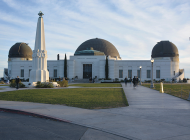
Griffith Observatory will host a live, online broadcast of the total lunar eclipse on March 13-14, from 8:50 p.m.-3:05 a.m., weather permitting. Griffith Observatory is not conducting onsite public viewing for the eclipse and Griffith Park will not be open.
If skies are clear, the eclipse should be visible to the unaided eye from anywhere in Southern California. It is safe to view a lunar eclipse without any eye protection. Viewers do not need a telescope to see a lunar eclipse. Everyone is encouraged to go outside and look to the southeast to observe the start of totality at 11:26 p.m. The appearance of the Moon changes dramatically during the course of an eclipse, and it is worth viewing on multiple occasions during the evening.
A time-lapse version of the lunar eclipse feed will be available on Griffith Observatory’s YouTube Channel at 8 a.m. on March 14.
A total lunar eclipse occurs when the Moon passes directly and completely into the dark inner shadow, or umbra, cast by the Earth. On March 13, 100% of the round disk of the full Moon will slowly move into the dark shadow, and the bright Moon will grow dim. The Moon will not, however, become completely dark. Instead, it usually glows with a copper or red color, a result of sunlight being filtered and bent through the Earth’s atmosphere, much like a sunset. The next total lunar eclipse visible in Los Angeles will occur March 3-4, 2026.
For information, visit griffithobservatory.org.




0 Comment