




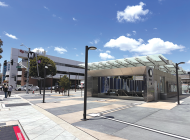
The project would replace an existing two-story apartment building at 140 S. Camden Drive. (photo by Tabor Brewster)
The Beverly Hills City Council on March 4 denied an appeal for a builder’s remedy project at 140 S. Camden Drive.
The project – a 15-story, 194-foot building with 27 residential units and four levels of underground parking – had been submitted by developers who hoped to make use of the state’s builder’s remedy provision. Six of the 27 units were reserved for low-income housing.
The housing law provision allows buildings to exceed local code restrictions such as height and density if the project contains a certain amount of affordable housing units. The builder’s remedy takes effect when a municipality’s housing element – effectively a zoning plan for affordable housing – is out of compliance with state requirements. The city of Beverly Hills housing element was out of compliance for three years between 2021-24, and received approval from the state’s Department of Housing and Community Development on May 1, 2024.
Developers Wilshire Camden, LLC filed a preliminary application for the project on March 15, 2024 – three days before the city adopted its certified housing element which was approved by the state later that year. Under state law, a development project has vested rights in accordance with ordinances, policies and standards in effect on the preliminary application filing date.
After submitting a preliminary application, a developer has 180 days to submit a formal application. After the formal application is submitted, the city has 30 days to respond. If the city does not respond within 30 days, the application is deemed complete by operation of law.
City staff deemed the application incomplete on Oct. 3, citing missing architectural details and missing environmental and technical studies as the basis for the incomplete determination.
However, the applicant argued that its application was deemed complete by operation of law because it sent a formal application on Friday, Aug. 30, which the city did not deem incomplete until Oct. 3. This would exceed the 30 days allowed for a city to respond to a formal application. However, the city argued that the formal application was technically submitted on Tuesday, Sept. 3, because fees were not paid for the formal application until after 5:30 p.m. on Aug. 30. The applicant sent the documents for the formal application at 12:32 p.m. on Aug. 30 and paid the fees after 5:30 p.m. According to a staff report, the city’s position is that “applications submitted (including payment) after City Hall business hours are considered submitted the next business day.”
In this case, due to Labor Day on Monday, Sept. 2, the next business day was Sept. 3.
The city sent its incomplete letter to the applicant at 4:59 p.m. on Oct. 3. However, a follow-up letter with a correction was sent at 7:03 p.m.
As a result, the developers filed an appeal for the city’s incomplete determination. The applicant cited the time frame discrepancy and noted that neither a general plan amendment nor zoning amendment is required for a builder’s remedy project – a law that Beverly Hills did not recognize until January 2025. Additionally, developers argued the formal development application did not substantially deviate from the preliminary application, which would maintain its vested rights as a builder’s remedy project.
The city also argued that the project had substantially changed from its initial application. In the preliminary application, the development was 175 feet tall with 26 units, while in the formal application it was 194 feet with 27 units.
However, housing law states that a project’s preliminary application retains vested rights unless the project’s overall residential units or square footage changes by 20% or more, which the project at 140 S. Camden Drive did not.
Ryan Leaderman, an attorney for the developers, presented the appeal to the City Council on March 4. Most of the argument centered around the date of the submission. He maintained that the applicant submitted the formal application on Aug. 30, and that the city’s rules on business hours do not exist anywhere in writing. Additionally, he argued that the city did not follow its own rules on business hours, as the city sent a follow-up to the incomplete determination on Oct. 3 at 7:03 p.m.
Leaderman also pointed to lawsuits that have arisen in local municipalities that have denied projects under similar circumstances.
“It could be quite dangerous if the city continues to violate the Housing Accountability Act,” Leaderman said.
After extensive back and forth discussion, including questions about the timeline of the application, the City Council upheld the city staff’s incomplete determination.
“No one’s disputing that there’s a housing shortage and we need to do what we can to have more housing and affordable housing,” Vice Mayor Sharona Nazarian said. “We want to work with developers, but we need to abide by rules and regulations. The application was incomplete … I too hope that we can revisit this with the project and reapply in a way that abides by the city rules.”
“As an attorney I am well aware of time limitations and certainly in the courts that I practice in, if I don’t get things in by 5 o’clock, I get a notation [that] this is considered to be filed whatever day it is – usually electronically they’ll tell me it’s the next day … I think it’s something that we’re all really as attorneys familiar with – that an act with the court is not complete until all those requirements are made,” Mayor Lester Friedman said. “I think the same holds true for the city. The applicant was certainly well aware of what it takes to get an application perfected so that it is properly filed.”
The council voted unanimously to deny the appeal.
“We believe that the city acted unlawfully [on March 4] in its denial of the project,” Leaderman said in an email to the Beverly Press following the meeting. “We are exploring all legal options and will respond accordingly.”
The city is currently engaged in two lawsuits over a similar denial of an appeal for a builder’s remedy project at 125-129 S. Linden Drive. One of those lawsuits was filed by the developer, Leo Pustilnikov, while the other was filed by housing advocacy nonprofit Californians for Homeownership. The group also won a lawsuit against the city in 2023 over its lack of a certified housing element.
In a statement to the Beverly Press, Californians for Homeownership counsel Matt Gelfand said the city’s denial of the appeal for the 140 S. Camden Drive project may prompt a third lawsuit from the group.
“The city’s latest builder’s remedy denial was based on transparently pretextual grounds and was unlawful,” Gelfand said. “Our organization has told the city that we are likely to file our third lawsuit against the city to compel the approval of this project.”

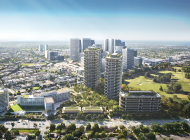
A rendering shows how the project would have been configurated. (rendering courtesy of CARA Architecture)





0 Comment