




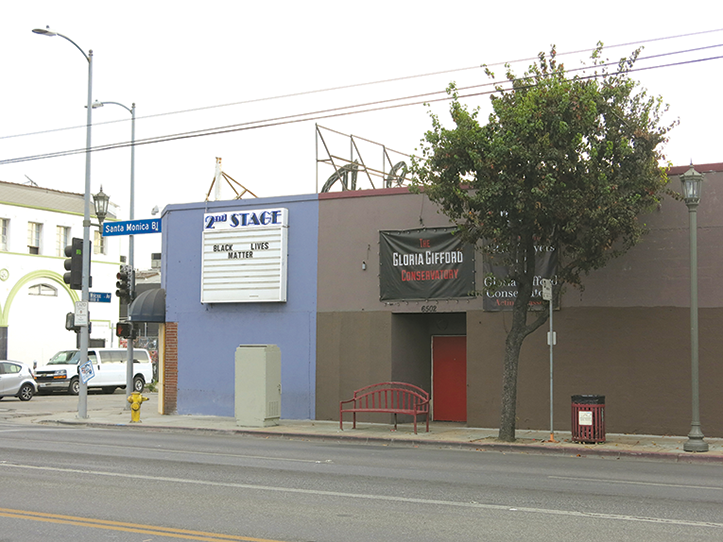
The Blank Theatre at Santa Monica Boulevard and Wilcox Avenue is one of the small venues in the Theatre Row District that remains closed due to public health orders. (photo by Cameron Kiszla)
The beginning of March was an exciting time for the Sacred Fools Theater Company, which operates the Broadwater theater complex at Santa Monica Boulevard and Lillian Way in Hollywood. The new play “Antigone Presented by the Girls of St. Catherine’s” opened on March 6, and everyone in the cast and production crew was upbeat and optimistic, managing director Padraic Duffy said.
Then the coronavirus changed everything. Like countless other businesses, the theater complex with four stages was forced to suspend production, close its doors and furlough employees. Months passed before there was any glimmer of hope, Duffy added.
“We had done one week of the new show and then we had to close. For five months, we were completely shuttered,” Duffy said. “In the last few months, we came back on a limited basis just for filming and things like that, but now we shut down again. Like most theater companies, we closed and thought we would be back in three weeks. Part of the problem is trying to plan for the future, and trying to pay your bills when you don’t know when revenues will come again. So, it’s trying to piece together different grants and relief funds to survive.”
Duffy added that optimism is naturally ingrained in theater artists, and he remains hopeful the curtain will soon rise again. A source of that optimism is a new live theater COVID-19 emergency grant fund under consideration by the Los Angeles City Council.
Introduced by Councilman Mitch O’Farrell, the $130,000 fund will help live performance venues, rehearsal spaces, rental equipment businesses and others related to theaters in the 13th District with operating expenses during the COVID-19 pandemic. Recipients would receive up to $5,000. The funds will come from arts development fees paid by developers when projects are approved.
“Due to the COVID-19 pandemic, public health guidelines have closed theaters across the city, limited filming and banned large gatherings,” O’Farrell said. “These major disruptions have led to mass layoffs and can potentially eliminate an entire and highly valued small theater industry if urgent action is not taken. Many theaters and their support services survive month to month. Without the revenue from shows, classes, rentals and ticket sales, these professional theaters could permanently close their doors.”
The funds will be particularly important to the many small theaters in the Theatre Row District, which was officially dedicated in 2015 by O’Farrell and then-Councilman Tom LaBonge, 4th District. The district is located along Santa Monica Boulevard between El Centro and Las Palmas avenues and includes approximately 20 stages. Most are small venues with 99 seats or less.
Daniel Henning, founding artistic director for the Blank Theatre at 6500 Santa Monica Blvd., also said the pandemic has presented many challenges, particularly for the Theatre Row District. He worked with O’Farrell and others to get the district established, and has lobbied for the new live theater emergency relief fund. He said the Blank Theatre is stable but remains closed with an uncertain future. He worried about some of the other smaller spaces that may not have the ability to turn to other sources of income.
“The theater world never thrives. If you look at it from sort of a capitalistic standpoint, it’s a loss leader. That’s why nonprofits exist, that’s why people make donations to keep the arts alive. Art just doesn’t bring in the same kind of money that commerce does, so we’re always at a disadvantage,” Henning said. “Many people can eke out their livings by renting theaters or by doing what they do, but it’s meager at best.”
Henning added that the Hollywood Fringe Festival – one of the biggest events of the year for the Theatre Row District – was cancelled in June because of COVID-19 and plans are uncertain about the 2021 festival. Some theaters use revenues from rentals during the Hollywood Fringe Festival to sustain them for the rest of the year, Henning added.
“I have great concerns of how the live theater community will evolve without a current source of revenue as a result of the safer-at-home order,” he said. “This grant program is much appreciated, and I am grateful I was able to lend my voice to the conversation with Councilmember O’Farrell to get this program started. This will help so many of us who are struggling to keep live theater going during the pandemic.”
The new fund is also supported by the Hollywood Chamber of Commerce, which is concerned about the future of an industry that is part of the fabric of Hollywood, President and CEO Rana Ghadban said.
“The Hollywood Chamber of Commerce wholeheartedly endorses Councilman O’Farrell’s emergency program grant initiative. We appreciate his help in helping us save jobs, which is what it comes down to,” Ghadban said. “Just like any other business, the impact of COVID has been devastating. We want to make sure theaters have the support they need to survive this pandemic and be able to reopen. We all look forward to the curtains reopening once more in Hollywood.”
O’Farrell’s motion instructs the Los Angeles Department of Cultural Affairs and the Los Angeles City Attorney’s Office to develop guidelines for an emergency fund benefitting live performance spaces. It is anticipated the grants will be for venues with 50 or fewer employees.
The motion was referred to the Health, Education, Neighborhoods, Parks, Arts and River Committee and is expected to come back to the full City Council in the coming weeks.


0 Comment