




Los Angeles Mayor Eric Garcetti appeared at a West Hollywood City Council meeting on Monday to help make sense of the dollars paid to the county’s lowest earners.

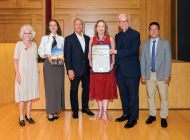
Los Angeles Mayor Eric Garcetti visited West Hollywood on Monday to encourage a raise in the city’s minimum wage, similar to a plan Los Angeles approved last year.
(photo by Gregory Cornfield)
But despite his advice to raise the minimum wage, West Hollywood City Council members ended up balking at a chance to join its neighboring city in raising the rate to $15 per hour by 2020. The current minimum wage in West Hollywood is $10 per hour and has been since the state raised it on January 1. Councilman John D’Amico called the plan “too aggressive” for West Hollywood. The prevailing concern was the uncertainty or risk the council members could be imposing on small business owners.
D’Amico and Mayor Pro Tem Lauren Meister proposed a substitute motion to direct the city to draft an ordinance raising the minimum wage to $12 an hour by July 2017 for businesses that have more than 25 employees. For businesses with 25 employees or fewer – which make up approximately 70 percent of businesses in the city – the increase will take effect in July 2018. Moving forward, the city will update minimum wage rates based on changes to the consumer price index. The motion passed 3-2.
“We’re going to do this, but we’re going to do this slowly,” D’Amico said.
D’Amico’s alternative allows West Hollywood to wait and see what happens in the November elections when three ballot measures could supersede their decision.
The Fair Wage Act 2016 would increase the state’s minimum wage by $1 each year, beginning Jan.1, 2017, until it reaches $15 in 2021. The Raise California’s Wage and Paid Sick Days Act of 2016 would increase the minimum wage for employers with 26 or more employees until it hits $20 per hour in July 2020. The initiatives are in the process of trying to qualify for the November 2016 ballot.
President and CEO of the West Hollywood Chamber of Commerce, Genevieve Morrill, said she is not opposed to raising the wage, but cautioned the city council to slow down and consider businesses that compete with national chains that can afford a higher cost of labor. She also explained that most West Hollywood businesses already pay above minimum wage, and that 80 percent of people who work in West Hollywood do not live in the city.
“Supporters of Raise the Wage, with no iota of information of our businesses, state that we want to deny the workers of West Hollywood a wage that allows them to adequately provide for their families,” Morrill said. “They give no consideration that these West Hollywood businesses are also just trying to feed their families, trying to keep their doors open and their employees employed.”
Councilman John Heilman explained that the city isn’t rushing forward. The city first considered the wage increases in 2014 and have had other meetings on the topic since.
“People who work in this city, whether it’s restaurants or hotels, they deserve a fair shake,” he said. “I want to make sure when I go and spend my money that the people who are serving me directly or indirectly are paid fair wages.”
Garcetti has been a vocal leader in the Raise the Wage campaign in Southern California.
“In America, if you look at the presidential campaign right now there’s a real sense that, even though we are out of the recession, too many people were left behind,” he said. “If you talk to economists who say yes, unemployment in cities like ours has been cut in half, but there’s not enough spending on Main Street, especially on the lower end of the spectrum.”
Garcetti explained that a raise isn’t as progressive or outlandish as it sounds when the minimum wage rate in 1968 would have been close to $12 per hour today, and the economy didn’t fall apart then.
“This is not a brave new jump forward, as much as we’d like to pat ourselves on the back and think that it is,” he said. “This is actually a return to something that was there.”
But West Hollywood’s city council members were not persuaded. D’Amico and Councilman John Duran explained that they did not want to make the decision based on what Los Angeles did because their economy and communities are very different and will be affected differently.
In 2014, West Hollywood businesses employed 26,161 workers. Food service workers make up 26 percent of the city’s total employment, with retail and health care services each making up about 15 percent of total employment. By comparison, food service workers make up 9 percent of all employees in Los Angeles.
Beyond other demographic differences, Duran explained that everyone in West Hollywood on average lives 500 feet from a business. He said the city has very few fast food restaurants, and non-chain restaurants in West Hollywood don’t see the employee turnover rates that they see in Los Angeles.
“We have a community that’s very unique,” Duran said. “Raising the wage was needed in other places.”
Duran echoed D’Amico that West Hollywood might need to take a step back. He explained smaller municipalities may feel frustrated by the federal government’s lack of action, as the country’s minimum wage is still $7.25, set in 2009. But he said West Hollywood should be very careful.
“Smaller cities are cautious that we could make a mistake and not be able to recover from it,” he said.
Part of what made the decision difficult was the complexity involved with tipped workers. West Hollywood businesses asked the city to consider incorporating a “subminimum wage” or a total compensation provision into any minimum wage law it adopts. A subminimum wage is a two-tiered wage system that permits an employer to pay less than the minimum wage to tipped employees who regularly receive at least $30 per month in tips. Currently, the federal subminimum wage is $2.13 per hour and the maximum tip credit that an employer can claim is $5.12 per hour. Forty-three states and the District of Columbia allow subminimum wage; California does not. Total compensation creates a system in which employers can claim medical benefits, bonuses, pensions, meals, sick days or other benefits that could be equated with wages.
After the vote, Horvath said she was embarrassed that the city “failed to act as leaders,” and hopes they reconsider making a commitment to $15 an hour by 2020.
“By doing less we’re basically saying the status quo is acceptable,” she said.
City staff will reach out to the business community to assess how owners feel it would be best to move forward.






0 Comment