




As efforts continue to establish a metro line in West Hollywood, advocates are pushing for more community support.

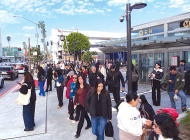
Community members take a look at three proposed Metro lines that could connect West Hollywood to the rest of L.A. County.
(photo by Patricia Sanchez)
On Tuesday, city staff collaborated with West Hollywood Advocates for Metro Rail (WHAM) to raise awareness, and the city council voted to support an extension option that could run along San Vicente Blvd. to Santa Monica Blvd.
The city hosted the “Tacos and Transit” community event on Tuesday evening to inform the public about three potential lines proposed in the county extension project, and gave residents the option to sign a petition in favor of bringing a Metro line to the city. The proposed Crenshaw/LAX Northern Extension light rail transit line would provide a north-south connection for the city.
The city council’s vote to push for a San Vicente to Santa Monica Boulevard line follows the council’s decision on Dec. 21 to fund research efforts and community outreach to bring the Metro line to West Hollywood and to explore raising the city sales tax to help pay for construction. The potential tax increase is on hold for now in order to focus on getting community support for a Metro line, according to Councilman John Duran.
Along with the San Vicente to Santa Monica route, which would run nine miles, Metro is considering a San Vicente Boulevard to La Brea Avenue route totaling six miles and a San Vicente to Fairfax route totaling 7.5 miles.
According to Duran and Bianca Siegl, West Hollywood’s long-range mobility planning manager, advocating for the San Vicente to Santa Monica route is the best option.
Siegl said although the line is the longest and the most expensive route with an estimated cost of $6 billion, it outperformed other routes in research that examined population, employment, walkability and demographics along the proposed routes. The line would serve an estimated 13,000 daily riders on the existing Crenshaw line and pass important city destinations including Cedars-Sinai Medical Center, West Hollywood Library and the Beverly Center. If the line is extended, ridership could increase by approximately 39,900 riders. It would also give the city the most flexibility in the long run.
Advocating for the most expensive route, Siegl explained, would give the city the biggest budget to work with even if they decide to build along another route.
“Picking one line to advocate for now will further allow us to build partnerships with other stakeholders that will help us to make sure this project is appropriately prioritized on Metro’s list,” Siegl said.
While the city council voted unanimously for the San Vicente to Santa Monica Boulevard line, some city council members, including Mayor Pro Tem Lauren Meister, had concerns about the research conducted for the proposed line.
“I feel like we spent a lot of money to get to this point when there was an obvious direction [staff] wanted us to go,” Meister said. “I’m not saying this is the wrong choice, but that’s kind of an issue that I’ve had with some of our projects. There’s a point of view and then there’s data to support that point of view instead of going from the data to a conclusion.”
All council members agreed, however, that it is important to go before Metro with a strong and united front.
WHAM member Dan Wentzel said choosing the best route and getting community support is vital to making the proposed Crenshaw/LAX Northern Extension project a reality.
“In 2008, West Hollywood voted with a higher yes percentage for Measure R than any other city in Los Angeles County because this city wants a Metro rail here,” Wentzel said. “The extension of the Crenshaw line from LAX through West Hollywood is an excellent option. There’s always more we can do to help traffic relief to keep Los Angeles moving. Mobility is highly important for a densely populated place like West Hollywood.”
Karen Eyres, who has lived in West Hollywood for the past 15 years, said she has been following the city’s plans for a Metro line and believes bringing it to West Hollywood is a great idea.
“I am a supporter of anything that improves the mass transit system,” Eyres said. “I’ve been riding the bus for nearly 15 years, and current subway lines don’t really help me with my commute to work. [West Hollywood] has been very open to mass transit, and I think it’s important to the people who live and work here.”
Metro staff will conduct its own studies this month on the feasibility of the three routes, and in March, they will submit a draft expenditure plan to the Metro Board for consideration of priority transportation projects. Approved projects will go into Metro’s proposed 2016 countywide ballot measure to raise the overall sales tax from 9 to 9.5 percent to pay for Metro projects.
Siegl said because final expenditure plans are expected to be adopted in June by the Metro Board, now is a critical time to raise awareness about the proposed Metro lines.
“Timing is critical because Metro is hearing a lot of different proposals for new lines, and we need to make sure our city is not left out in that conversation,” Siegl said.
Moving forward, city staff and WHAM will continue to gain community support. So far, their efforts have yielded 3,000 signatures from residents who support a Metro line.







0 Comment